
Imagine your child’s school is raising money for a new playground. Every family has to contribute, but nobody at the school gets a say in how much they’ll pay or how the money will be used. Someone hundreds of miles away is making those decisions.
You might wonder, “Why don’t we get a say?”
That’s remarkably close to the question American colonists were asking more than 250 years ago.
When Britain began imposing new taxes on its American colonies, many colonists weren’t simply upset about paying more money. They believed something more important was at stake: their right to have a voice in decisions that affected their lives.
Their frustration became one of the most famous phrases in American history:
No taxation without representation!
But what did those words actually mean?
The Colonists Already Had Their Own Governments
Long before the American Revolution, the 13 Colonies had developed their own local governments.
Most colonies had elected assemblies where representatives helped make laws, approve spending, and decide how taxes would be collected. These assemblies weren’t democracies in the way we understand democracy today. Voting was generally limited, and many people living in the colonies had no vote.
Still, for colonists who could participate, elected assemblies were an important part of how their communities governed themselves.
The colonists also paid taxes. They understood that governments needed money for roads, public buildings, defense, and other expenses.
What mattered to many of them was that their elected representatives had a say in those decisions.
After the French and Indian War, however, Parliament began asserting its authority to tax the colonies more aggressively, bringing a long-standing disagreement about government powers into the open.
The Problem With Parliament
As we explored in our previous article, Britain emerged from the French and Indian War in 1763 with enormous debts. British leaders believed the colonies should help pay for the war and the cost of maintaining soldiers in North America.
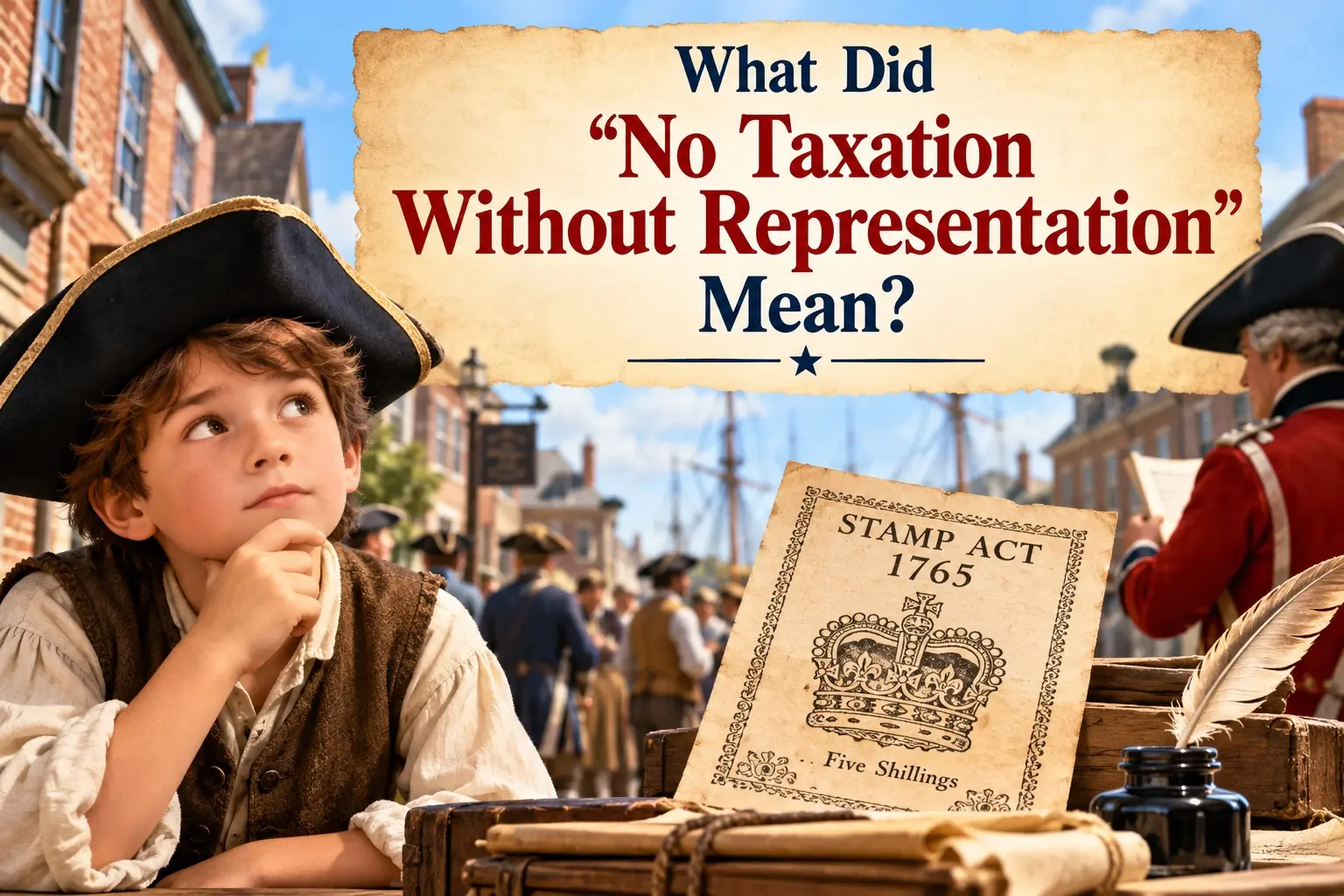
Parliament began introducing new taxes, including the Stamp Act of 1765, which required special tax stamps on newspapers, legal documents, playing cards, and other paper items.
There was just one problem from the colonists’ point of view.
The American colonies did not elect anyone to the British Parliament in London.
Think about that for a moment. A law was being passed thousands of miles away, requiring people in the colonies to pay money, but they had no elected representatives in the legislature making that decision.
Many colonists believed this violated their rights as British subjects.
They weren’t necessarily demanding independence. At this point, many still considered themselves loyal to Britain. They simply believed that taxes should require the consent of the people through their elected representatives.
But Britain Saw Things Differently
Here’s where the story becomes particularly interesting: British leaders didn’t believe they were doing anything unusual.
In Britain itself, many people couldn’t vote in parliamentary elections. Some towns didn’t even have their own representatives in Parliament.
British officials argued that members of Parliament were supposed to consider the interests of everyone in the empire, not just the people who had elected them.
This idea was called virtual representation.
In other words, British leaders believed Parliament could represent the colonists’ interests even though the colonists didn’t elect its members.
Many Americans disagreed.
They already had representatives they could elect to their colonial assemblies. Those representatives lived in their communities, understood local concerns, and could be held accountable by the voters.
Why, they asked, should Parliament be able to bypass those assemblies when collecting taxes?
The disagreement wasn’t really about whether government needed money. It was about who had the authority to make decisions and whose consent mattered.
A Disagreement That Brought Colonies Together
When the Stamp Act was passed in 1765, the colonies responded with petitions, public protests, and boycotts of British goods.
That October, representatives from nine colonies met in New York for the Stamp Act Congress. They defended the idea that taxes should be imposed with the consent of the people through their representatives.
The meeting was significant because the colonies weren’t one united country. Each had its own government and interests, yet representatives were beginning to work together over rights they believed they shared.
Britain repealed the Stamp Act in March 1766, but there was a catch. On the very same day, Parliament passed the Declaratory Act, reaffirming its authority to make laws for the colonies in all cases.
The unpopular tax was gone, but Parliament had not given up its claim to govern the colonies.
As new taxes and restrictions followed, colonists continued asking the same question: Who had the right to make laws and collect taxes from the people living in America?
What Does Representation Actually Mean?
This is where the story connects to something children can understand.
Representation means having someone speak or make decisions on behalf of other people. In government, elected representatives are chosen by voters to help make laws and decisions for their communities.
That doesn’t mean everyone will always agree with every decision. Even when people elect representatives, they may disagree about taxes, spending, or what the government should do.
But having a voice in choosing those representatives is very different from being governed by people you had no opportunity to elect.
For many American colonists, that difference was worth defending.
Their arguments about representation would eventually become part of a much larger debate about liberty, rights, and self-government.
Make Your Voice Count: Talk About It With Your Child
Here’s a simple way to bring the idea to life.
Imagine your child’s neighborhood is planning a new park. Everyone will help pay for it, but only one person can attend the meeting where decisions are made.
Ask your child:
- Who would you choose to speak for your family?
- What would you want that person to say?
- What if the final decision wasn’t the one you wanted?
This helps children understand an important lesson: having representation doesn’t guarantee you’ll always get your way. It means having a voice in how decisions are made, even when people disagree.
And that’s an idea that still matters today.
Why Those Five Words Mattered
The belief that taxes should require the consent of the people through their representatives had roots in English political traditions long before the American Revolution.
What made the colonial dispute so important was how strongly many Americans defended that principle when they believed Parliament was violating it.
Over time, the conflict raised even larger questions. How much authority should a distant government have? Who gets to make laws? And what happens when people believe their rights aren’t being respected?
The colonists didn’t all agree on the answers, and independence wasn’t their original goal. But the disagreements encouraged them to defend their rights, cooperate across colonial boundaries, and reconsider their relationship with Britain.
Those arguments became an important part of America’s journey toward independence.
Continue the Story
For years, the colonists had protested British taxes through petitions, public meetings, and boycotts. But tensions continued to grow, particularly over the tax on tea.
In December 1773, a group of protesters in Boston took a much more dramatic step, destroying an enormous shipment of tea.
The Boston Tea Party would become one of the most famous acts of protest in American history, and there’s much more to explore about what happened that night and why.
Want to introduce your child to the people and events behind America’s founding in a fun, screen-free way?
America’s Birth: The Road to Independence is a coloring and activity book that invites young historians to explore the story through illustrations, maps, and engaging activities. It’s a fun starting point for questions, conversations, and discoveries about American history.
Explore America’s Birth in the ASF Shop
Sources & Further Reading
Explains colonial objections to taxation without elected representation, the arguments presented by the Stamp Act Congress, and their roots in English political traditions.
Explores colonial assemblies, Parliament’s position on representation, and the growing disagreement over taxation and political authority.
Presents the British government’s argument for parliamentary taxation, the colonists’ objections, virtual representation, and the Stamp Act’s repeal alongside the Declaratory Act.
Examines the colonists’ arguments about elected representatives, political rights, and government accountability.
Provides historical background on Britain’s revenue measures and the opposition to the Stamp Act.
Confirms that Parliament passed the Declaratory Act on the same day it repealed the Stamp Act in 1766.