
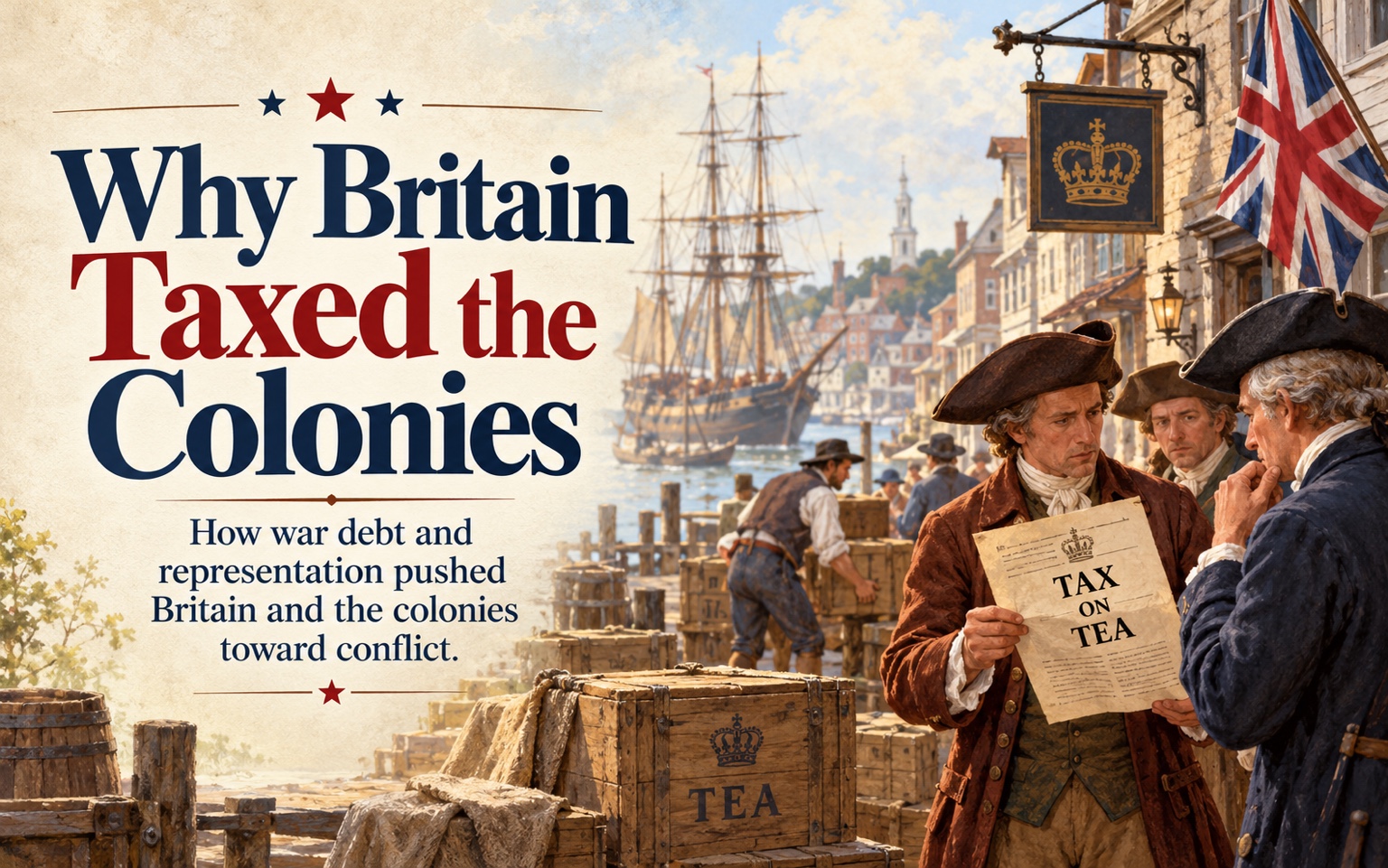
Imagine living in colonial America in 1765. Britain has just announced a new tax. Beginning that November, newspapers, legal documents, playing cards, and many other paper items will require a special tax stamp.
People are furious. Protests spread, merchants refuse to buy British goods, and representatives from different colonies begin working together. And it all started with a tax. This was the Stamp Act, one of the biggest turning points in the growing disagreement between Britain and its American colonies.
But why did Britain introduce these taxes in the first place? And why were the colonists so determined to resist them? The story begins with a war.
Britain Wins a War—and Faces a Mountain of Debt
Between 1754 and 1763, Britain and France fought for territory and influence in North America during the French and Indian War. Native American nations also participated, forming different alliances based on their own interests. The fighting eventually became part of a much larger international conflict called the Seven Years’ War.
Britain won, gaining control of important territory. But victory came at an enormous cost. The British government had borrowed heavily to pay for the war, and keeping soldiers in North America would cost even more money. British leaders believed the colonies had benefited from Britain’s victory and protection. They thought the colonists should help cover those expenses.
That might sound reasonable. After all, governments need money to operate, and defending territory is expensive. But the colonists had a different concern.
Didn’t the Colonists Already Pay Taxes?
Yes! The colonists already paid taxes to support their local governments. Each colony had its own system of government, and many had elected assemblies whose members helped decide how local money would be raised and spent. The problem was that the colonists did not elect representatives to the British Parliament in London.
Britain had long collected duties on colonial trade, but after the war, Parliament began introducing new measures intended to raise revenue from the colonies. Many colonists believed taxes should be approved by representatives they had actually elected. That disagreement became famous through a phrase you may recognize:
No taxation without representation!
It didn’t mean colonists wanted everything for free. They were questioning whether Parliament had the right to tax them without their consent through elected representatives. And Britain’s next major tax would bring the argument into the everyday business of colonial life.
The Stamp Act Changes Everything
In 1764, Parliament passed the Sugar Act, revising taxes on certain imported goods and strengthening enforcement of trade laws. Merchants objected, but an even bigger controversy was coming. The following year, Parliament passed the Stamp Act.
This law required many printed materials and legal documents used in the colonies to carry a special stamp showing that a tax had been paid. Think about how often people needed paperwork. Newspapers carried information, merchants kept records, and legal documents were part of buying property and conducting business.
The Stamp Act affected many ordinary transactions, making it difficult for colonists to ignore. For British leaders, it was a way to raise money to help support the colonies’ defense. For many colonists, it raised a troubling question: If Parliament could impose this tax without their consent, what might it tax next?
Resistance quickly spread.
How One Tax Brought Colonies Together
Colonists responded to the Stamp Act in several ways. They organized public meetings, published arguments in newspapers, and protested in the streets. Merchants and consumers also boycotted British goods, hoping that lost sales would pressure British businesses and Parliament.
Groups such as the Sons of Liberty helped organize opposition. Not every protest was peaceful; some crowds threatened officials and damaged property. But something particularly important happened in October 1765. Representatives from nine colonies gathered in New York for the Stamp Act Congress.
Remember, the 13 Colonies were separate colonies with their own governments and interests. They didn’t always agree, and they certainly weren’t one country. Yet representatives were now meeting to defend rights they believed they shared. They prepared petitions explaining why they opposed the tax and asking Britain to change course.
The protests, petitions, and boycotts created growing pressure on Parliament. And in March 1766, Britain repealed the Stamp Act. The colonists had won an important victory.
So why didn’t the disagreement end there?
The Tax Was Gone, but the Problem Remained
Although Parliament repealed the Stamp Act, it passed another law that same year called the Declaratory Act. This law asserted Parliament’s authority to make laws for the colonies. Britain had removed the unpopular tax, but it had not accepted the colonists’ argument about representation.
In 1767, Parliament introduced the Townshend Acts, placing new duties on imported goods including glass, paper, paint, lead, and tea. Colonial protests and boycotts returned. Most of those duties were repealed in 1770, but Britain kept the tax on tea.
Even when Britain withdrew a tax, the same argument kept returning: Who had the right to make these decisions? British leaders believed Parliament had authority throughout the empire. Many colonists believed their elected colonial assemblies should control taxation within their colonies. At this stage, many colonists still wanted to remain British subjects. They were fighting over rights and government authority, not yet demanding independence.
But the relationship was becoming increasingly strained.
Why Did Tea Become Such a Big Deal?
Tea was a popular drink in colonial America, and by 1773, it had become a symbol of the dispute. That year, Parliament passed the Tea Act to help the struggling British East India Company sell its tea. Here’s a detail that often surprises people: The Tea Act did not introduce a new tax on tea.
The earlier tax was still in place. The new law changed how the company could sell tea, allowing it to offer tea at a more competitive price. British leaders hoped colonists would welcome the cheaper tea. But many colonists weren’t persuaded.
Buying the tea still meant paying a tax imposed by a Parliament in which they had no elected representatives. The new arrangements also threatened some colonial merchants. For those who had spent years challenging Parliament’s authority, cheaper tea didn’t solve the problem. The conflict was heading toward one of the most famous protests in American history: the Boston Tea Party. That’s a story we’ll explore in a future article.
Talk About It With Your Child
Imagine your town needs money to build a new playground. Would you feel differently if representatives elected by your community voted on the plan, compared with someone far away making the decision without asking anyone in your town?
What questions would you want answered before the money was collected? This simple comparison helps children understand why representation mattered so much to the colonists.
Continue the Story
The colonists weren’t united in every opinion, and independence wasn’t yet everyone’s goal. But their growing cooperation and determination to defend their rights would help shape the events leading toward the American Revolution.
In America’s Birth: The Road to Independence, children can explore these growing disagreements through coloring and activities as they discover how the 13 Colonies eventually became a new nation.
Next, we’ll take a closer look at the phrase at the heart of the conflict:
What did “No taxation without representation” really mean?
Sources & Further Reading
Explains Britain’s financial pressures after the French and Indian War, the Sugar Act, Stamp Act, and early colonial protests.
Historical context for colonial objections to parliamentary taxation and the Stamp Act Congress.
Details the Sugar and Stamp Acts, Britain’s financial concerns, and colonial reactions.
Covers repeal of the Stamp Act, the Declaratory Act, and the Townshend Acts.
Chronology of the events leading toward the Revolution, including the Tea Act of 1773.