
Imagine waking up tomorrow morning and discovering that there’s no electricity, refrigerator, running water, washing machine, or car.
Need water? Someone has to go get it. Want breakfast? Your family needs to grow, raise, make, or buy the food. Need a new shirt? You can’t simply order one and have it delivered.
For families living in colonial America, many things we take for granted required time, skill, and physical work.
Exploring everyday colonial life helps children understand the people who lived during America’s early history—and appreciate how much our lives have changed.
So what might your child’s day have looked like if they had grown up in colonial America?
There Wasn’t Just One Kind of Colonial Life
Life in the 13 Colonies wasn’t the same everywhere.
A farming family in Virginia lived differently from a merchant’s family in Philadelphia or a fishing family in Massachusetts. Climate, geography, wealth, occupation, and whether people lived in towns or the countryside all influenced daily life.
Life also changed over time. The earliest English settlers faced different challenges from families living in established colonial towns generations later.
Still, many everyday experiences help us understand how different their world was from ours.
Imagine Arriving in a New Settlement
Early English settlers crossed the Atlantic carrying tools, food, clothing, seeds, and other supplies. The journey could take weeks, and when they arrived, there wasn’t necessarily a house waiting or a nearby store to replace something they had forgotten.
They needed shelter, reliable water, food, and ways to prepare for changing seasons.
Native American communities were already established throughout the region. In some settlements, Native Americans shared valuable knowledge about local foods, agriculture, and the environment. Settlers also brought European tools, livestock, crops, and skills, adapting them to their new surroundings.
Over generations, settlers established farms, homes, workshops, churches, roads, mills, markets, and towns. Building and sustaining these communities required perseverance, cooperation, and ingenuity.
Imagine This
Ask your child to imagine that everything your family needs to begin a new life must fit aboard a ship crossing the Atlantic.
What would you bring? Which tools and supplies would be most important? What would you do when your food began running out?
It’s a simple way to help children imagine the challenges of establishing a new settlement.
What Were Colonial Homes Like?
Colonial homes varied depending on the family’s wealth, location, and time period. Some early homes were small and simple, while prosperous families in established communities might live in much larger houses.
But even a comfortable colonial home would seem unfamiliar today.
There were no electric lights, refrigerators, or air conditioning. Fireplaces provided warmth and were often used for cooking. Candles and lamps provided additional light.
Keeping a household running meant tending fires, preparing food, collecting water, and completing many tasks without modern appliances.
Want Water? Go Get It.
Today, most American children can turn on a faucet and have water immediately.
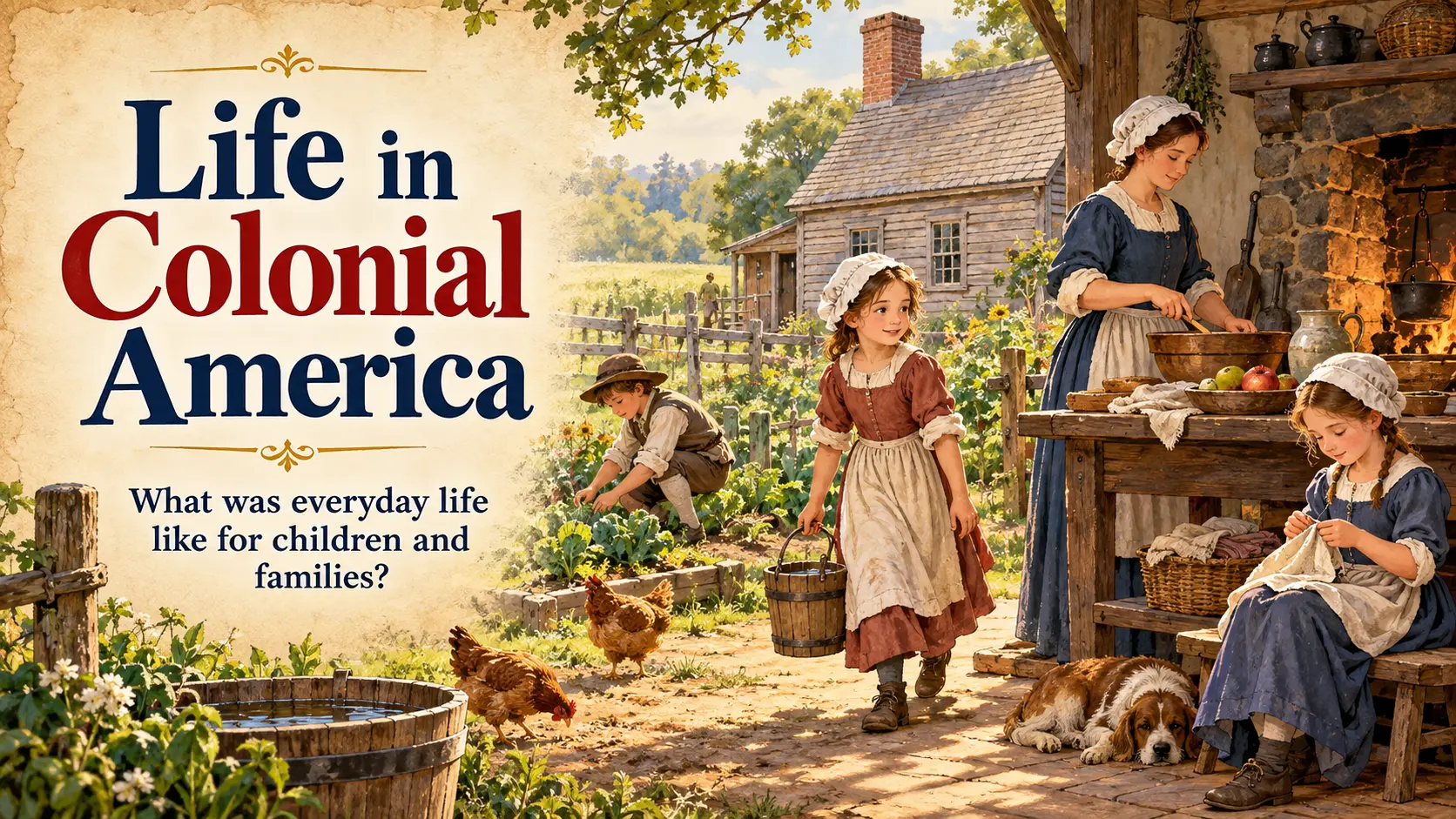
Colonial families often collected water from wells, springs, or pumps and carried it home. They needed it for drinking, cooking, cleaning, washing, and caring for animals.
Imagine how many buckets a family might need in a single day!
Try It: The Water Bucket Challenge
Give your child a small bucket with a safe, age-appropriate amount of water and have them carry it a short distance outside.
Then ask:
How would your day change if every bucket of water your family used had to be carried home?
The next time they turn on the faucet, they might appreciate it a little more.
What Did Colonial Families Eat?
Colonial diets depended on the region, season, family resources, and foods available locally.
Families might eat bread, corn, vegetables, fruit, meat, fish, and dairy products. Some grew or raised much of their food, while others purchased or traded for what they needed.
Without refrigerators, food had to be carefully stored or preserved. Drying, salting, smoking, and pickling helped families keep food for later.
Cooking usually involved a hearth or fire, making meal preparation more time-consuming than it is in many homes today.
What Did Colonial Children Do All Day?
Colonial children played, explored, learned, and spent time with friends and family, much like children today.
But they also helped with important household responsibilities.
Depending on their age and circumstances, children might:
- Feed animals or help in gardens
- Gather firewood or carry water
- Help prepare food and clean
- Sew, spin, or repair clothing
- Care for younger children
- Assist with farm work or a family trade
As they grew older, their responsibilities often increased.
A chore today might mean putting away toys. In a colonial household, a child’s work could help provide the family’s food, fuel, or clean clothing.
Did Colonial Children Go to School?
Education varied across the colonies. Some children attended schools, while others learned at home, studied with tutors, or trained in a trade through apprenticeships.
Opportunities depended on where children lived, their family’s resources, and local customs. Schooling wasn’t equally available to everyone.
Children might study reading, writing, arithmetic, and religion. In parts of New England, Protestant communities placed particular importance on reading the Bible.
Much learning also happened through everyday experience, as children observed adults and practiced skills they would need later in life.
What Did Colonists Wear?
Colonial clothing was often made from wool, linen, leather, and cotton. Styles varied depending on the family’s wealth, occupation, region, and the occasion.
Clothing could be expensive and time-consuming to produce. Fabric might require spinning, weaving, cutting, and sewing before it became a finished garment.
Rather than replacing clothing whenever something wore out, families often repaired, altered, and handed down garments.
Even an ordinary shirt represented someone’s time and skill.
What Jobs Did Colonists Have?
Farming was a major part of colonial life, but growing communities needed many different trades.
Blacksmiths made and repaired metal tools. Carpenters built homes and furniture. Printers produced newspapers and other materials. Merchants, sailors, fishermen, millers, shopkeepers, and other workers helped communities function.
Women contributed enormously to household and family economies through food preparation, clothing production, gardening, child care, and work on farms and in family businesses.
Knowing how to grow, build, repair, or make things was valuable in a world without today’s specialized services.
Faith and Community in Colonial America
Faith played an important role in many colonial communities.
Religious traditions and laws differed across the colonies, but churches and congregations often served as gathering places. Religious beliefs influenced family life, education, community traditions, and ideas about responsibility.
Some settlers came seeking greater freedom to practice their religious beliefs, although religious freedom varied across the colonies. For many families, faith also provided strength during difficult and uncertain times.
Religion was an important part of how many colonists understood their lives and communities.
Did Colonial Children Have Fun?
Absolutely! Colonial children didn’t spend every moment working.
They played games, sang songs, told stories, and enjoyed time outdoors with friends and family.
Popular toys and games included dolls, balls, hoops, tops, and marbles. Some toys were homemade, and many games required little more than imagination and a few simple materials.
Children hundreds of years ago enjoyed playing and having fun, just as children do today.
What Can Colonial Life Teach Us Today?
Colonial life could be demanding. Illness, difficult weather, slow travel, and shortages created challenges that many families today rarely experience.
Yet generations of people built homes, raised families, learned trades, established businesses, worshipped, helped neighbors, and developed communities that became part of America’s foundation.
Their perseverance, faith, practical skills, and ingenuity helped shape the world that later generations inherited.
One of the most meaningful ways to explore colonial life with children is to compare everyday experiences. Try carrying water, making butter, washing a small piece of clothing by hand, or playing a historical game together.
Then ask:
Which modern convenience are you most grateful for?
The goal isn’t to convince children that life in the past was terrible. It’s to appreciate the work of earlier generations and the inventions and improvements that followed.
What Will Your Generation Build?
Now imagine explaining today’s world to a colonial child.
We can light a house by flipping a switch, keep food cold, travel hundreds of miles in a few hours, and speak instantly with someone far away.
Much of our everyday life would have seemed extraordinary 250 years ago.
So what might life look like 250 years from now?
Each generation inherits knowledge, tools, and communities from those who came before it. Then it has opportunities to solve new problems, make discoveries, and build something better.
Ask your child:
If you could invent something that would make life better for Americans 250 years from now, what would you create?
What problem would it solve? Who would it help?
Have your child draw the invention and give it a name.
Perhaps one of the children learning about colonial America today will create something that children in the year 2276 will take for granted.
History helps us appreciate what earlier generations accomplished while encouraging us to imagine what future generations might achieve.
Continue the Story
Understanding everyday colonial life helps children see the people behind the events of the American Revolution.
The colonists who would soon debate taxes, representation, and independence were farmers, merchants, craftspeople, parents, and families living ordinary lives when extraordinary events began unfolding around them.
In America’s Birth: The Road to Independence, children can explore that story through coloring and activities, discovering how the 13 Colonies eventually became a new nation.
Next, we’ll explore a question that helped set those events in motion:
Why did Britain begin taxing the colonies?
Sources & Further Reading
Historical maps and primary-source activities exploring how geography influenced colonial settlements and regional differences.
Historical evidence on religious life and the importance of faith in colonial communities.
The challenges of early English settlement, including shelter, food supplies, disease, and relationships with Native Americans.
Children’s chores, homemade toys, games, and recreation in colonial America.
Resources on colonial occupations, households, clothing, trades, and the experiences of ordinary people.
Research on colonial children’s education, games, clothing, household responsibilities, and everyday experiences.