
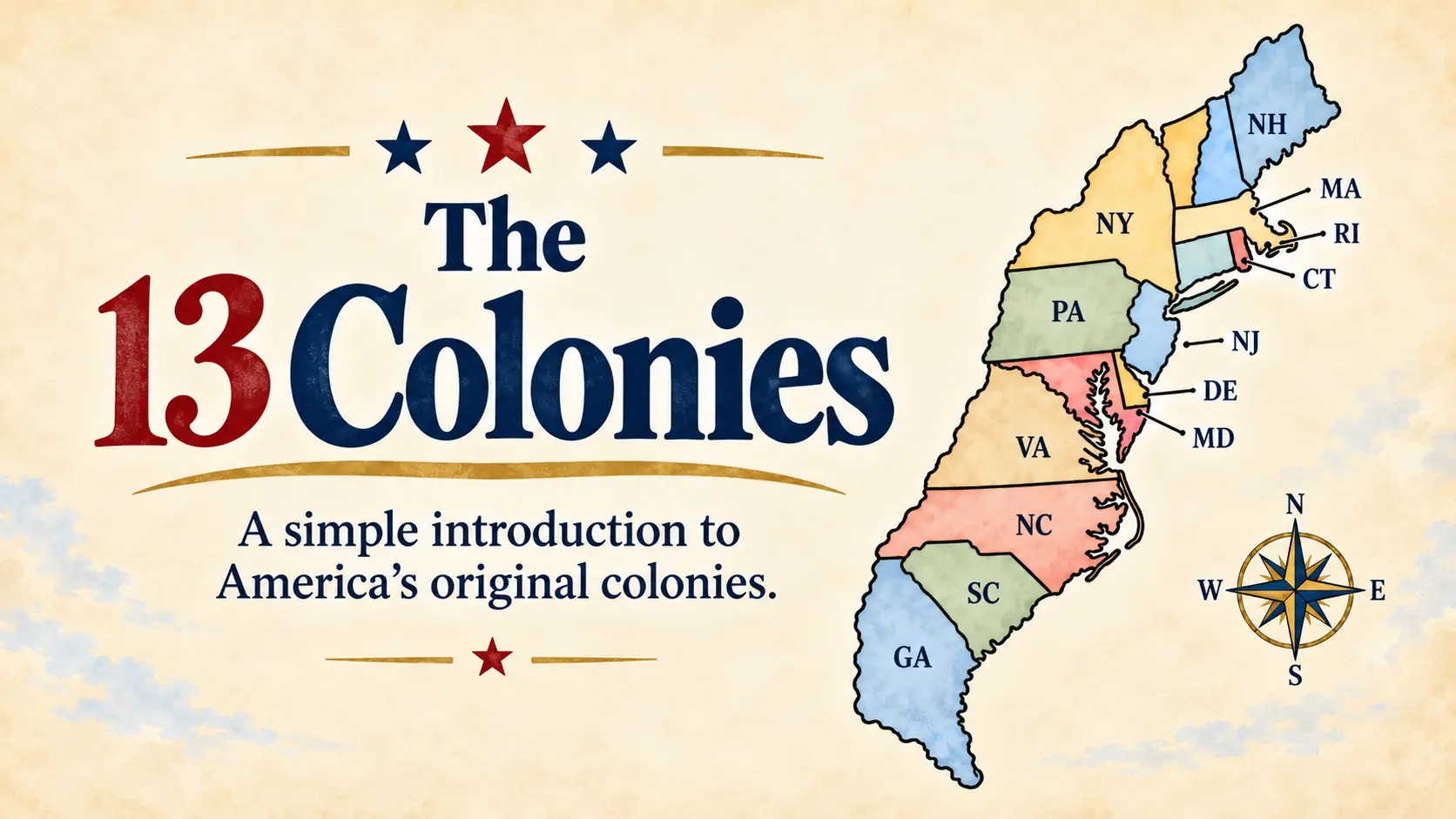
Have you ever had a child ask why the American flag has 13 stripes? The answer takes us all the way back to the beginning of the American story. Long before there were 50 states, there were 13 British colonies along the Atlantic coast of North America. They weren't one united country yet. Each colony had its own history, economy, communities, and local government. Over time, those 13 separate colonies would become the first 13 states of the United States. If you're introducing your child to early American history or the American Revolution, understanding the colonies is a great place to start.
What Were the 13 Colonies?
A colony is a settlement or territory governed by another country. The 13 Colonies that eventually became the United States were part of the British Empire. English settlers began establishing permanent communities in North America during the early 1600s. The first permanent English settlement was Jamestown, established in Virginia in 1607. Thirteen years later, the Mayflower arrived at Plymouth in 1620, carrying the group of settlers we remember as the Pilgrims. Crossing the Atlantic and establishing a new community required tremendous courage and perseverance. Settlers arrived without modern transportation, machinery, medicine, grocery stores, or instant communication. They had to build homes and communities, find or grow food, establish trades, and adapt to unfamiliar surroundings. Over the following generations, small settlements grew into farms, towns, ports, and cities. By the time of the American Revolution, the 13 Colonies stretched along the Atlantic coast from what is now New Hampshire to Georgia.
What Were the Original 13 Colonies?
From north to south, they were:
- New Hampshire
- Massachusetts
- Rhode Island
- Connecticut
- New York
- New Jersey
- Pennsylvania
- Delaware
- Maryland
- Virginia
- North Carolina
- South Carolina
- Georgia
All 13 eventually became states—and those original colonies are still represented by the 13 stripes on the American flag today. For children, this is one of the easiest connections to make between colonial history and something they already recognize. The next time you see an American flag together, have your child count the stripes and see if they remember what the number 13 represents.
The Three Colonial Regions
When children study the 13 Colonies today, they're usually divided into three geographic regions: New England, Middle, and Southern. This isn't just a convenient way to memorize them. Geography helped shape how the colonies developed. Climate, soil, rivers, harbors, natural resources, and the length of the growing season all influenced where people settled and how they made a living.
The New England Colonies
The New England Colonies were:
- New Hampshire
- Massachusetts
- Rhode Island
- Connecticut
New England had cold winters and rocky soil that made large-scale farming difficult in many areas. Its geography provided other opportunities. Forests supplied lumber, while rivers and access to the Atlantic supported fishing, trade, and shipbuilding. Religious belief also played an important role in the founding and development of several New England communities.
The Middle Colonies
The Middle Colonies were:
- New York
- New Jersey
- Pennsylvania
- Delaware
The Middle Colonies had productive farmland as well as important rivers and ports. Farms produced wheat and other grains, while trade helped cities grow. The region attracted settlers from a variety of backgrounds and religious traditions. Philadelphia became one of colonial America's most important cities and would later play a major role in the founding of the United States.
The Southern Colonies
The Southern Colonies were:
- Maryland
- Virginia
- North Carolina
- South Carolina
- Georgia
The Southern Colonies generally had warmer weather and longer growing seasons, making agriculture an especially important part of their economies. Depending on the location, farmers grew crops such as tobacco, rice, and indigo. Farms varied greatly in size, from smaller family farms to large plantations. Virginia was also home to Jamestown, giving the Southern Colonies an important place in the earliest history of permanent English settlement in North America.
The Colonies Weren't All the Same
It's easy for children to hear "the 13 Colonies" and imagine that they were essentially 13 pieces of one country. They weren't. The colonies had different beginnings, economies, religious traditions, and strong local identities. People had crossed the Atlantic for many reasons. Some sought economic opportunity or land. Some hoped to build new communities. Others came seeking greater religious freedom. Travel and communication also looked nothing like they do today. A journey of roughly 800 miles from Georgia to Philadelphia could take two or three weeks by land. Those distances helped make each colony feel even more separate. By 1775, about 2.5 million people lived in the 13 Colonies. Yet they were still British subjects living in separate colonies—not citizens of a country called the United States of America. That's an important concept for children to understand before learning about the Revolution:
America had to become America.
The 13 Colonies didn't remain British colonies forever. As disagreements with Britain grew, the colonies began working together in ways they hadn't before. That story eventually led to the American Revolution, the Declaration of Independence, and the creation of the United States. But before children learn how the colonies became a country, it helps to understand what those colonies actually were.
5 Facts About the 13 Colonies to Share With Your Child
1. The 13 stripes on the American flag represent the original colonies.
The number of stars has grown as states joined the Union, but the flag still has 13 stripes.
2. Jamestown was established before Plymouth.
Jamestown was founded in Virginia in 1607. The Mayflower arrived at Plymouth in 1620.
3. Traveling between colonies could take weeks.
A journey that we can make relatively quickly today could require weeks of difficult travel in colonial America.
4. Philadelphia was already a major city before the Revolution.
By 1775, approximately 30,000 people lived there. It would soon become one of the most important meeting places of America's founding generation.
5. The colonists didn't start out trying to create the United States.
The colonies developed over generations as parts of the British Empire. Independence came much later.
An Easy Way to Teach the 13 Colonies
If you're teaching this topic at home, start with a map rather than asking your child to memorize 13 names from a list. First, locate the colonies from New Hampshire in the north to Georgia in the south. Then color-code the three regions:
- New England
- Middle
- Southern
Once your child recognizes the regions, practice identifying the individual colonies. Finally, compare a map of the 13 Colonies with a map of the United States today. That simple comparison helps children see something that's easy to miss when history is taught only through words:
The United States began with just 13 states.
You can also connect the map back to the American flag. Have your child count the 13 stripes and explain what they represent. When children can connect a map, a symbol, and a story, the information becomes much easier to remember.
Why the 13 Colonies Matter
Children don't need to memorize every detail about colonial America before learning about the Revolution. They do need to understand the big picture. The 13 Colonies were separate British colonies with different histories, economies, geography, and local identities. Understanding where they were and how they developed gives children a foundation for everything that comes next. The United States didn't simply appear in 1776. It grew from settlements into colonies, from colonies into states, and ultimately from 13 states into the nation we know today. Understanding those beginnings helps children understand the rest of the American story.
Continue the Story
Once your child understands where the 13 Colonies were and how they differed, a natural next question is: What was it actually like to live there? That's where we'll go next as we explore colonial homes, food, work, school, clothing, chores, and everyday family life. The 13 Colonies are also where the journey begins in America's Birth: The Road to Independence. Through coloring, activities, and history, children can follow the colonies as disagreements with Britain grow and discover how 13 separate colonies eventually became a new nation.
Sources & Further Reading
Historical information for this article was researched and cross-checked using educational resources from the following institutions:
Information about the original 13 colonies and their transition into states.
Background on the 13 stripes of the American flag and their connection to the original colonies.
Information about Jamestown, Plymouth, colonial geography, economies, and early government.
Information about colonial population, travel, Philadelphia, colonial identity, and the movement toward independence.
Geography and Its Impact on Colonial Life and historical maps of the 13 Colonies
Resources exploring the geography of colonial America and how geography influenced the development of different regions.